The Generation Watching Us: Why Creators Carry More Responsibility Than Ever
Millions of young people now grow up with digital creators as everyday role models. Influence becomes meaningful when it leaves the next generation stronger than it found them.
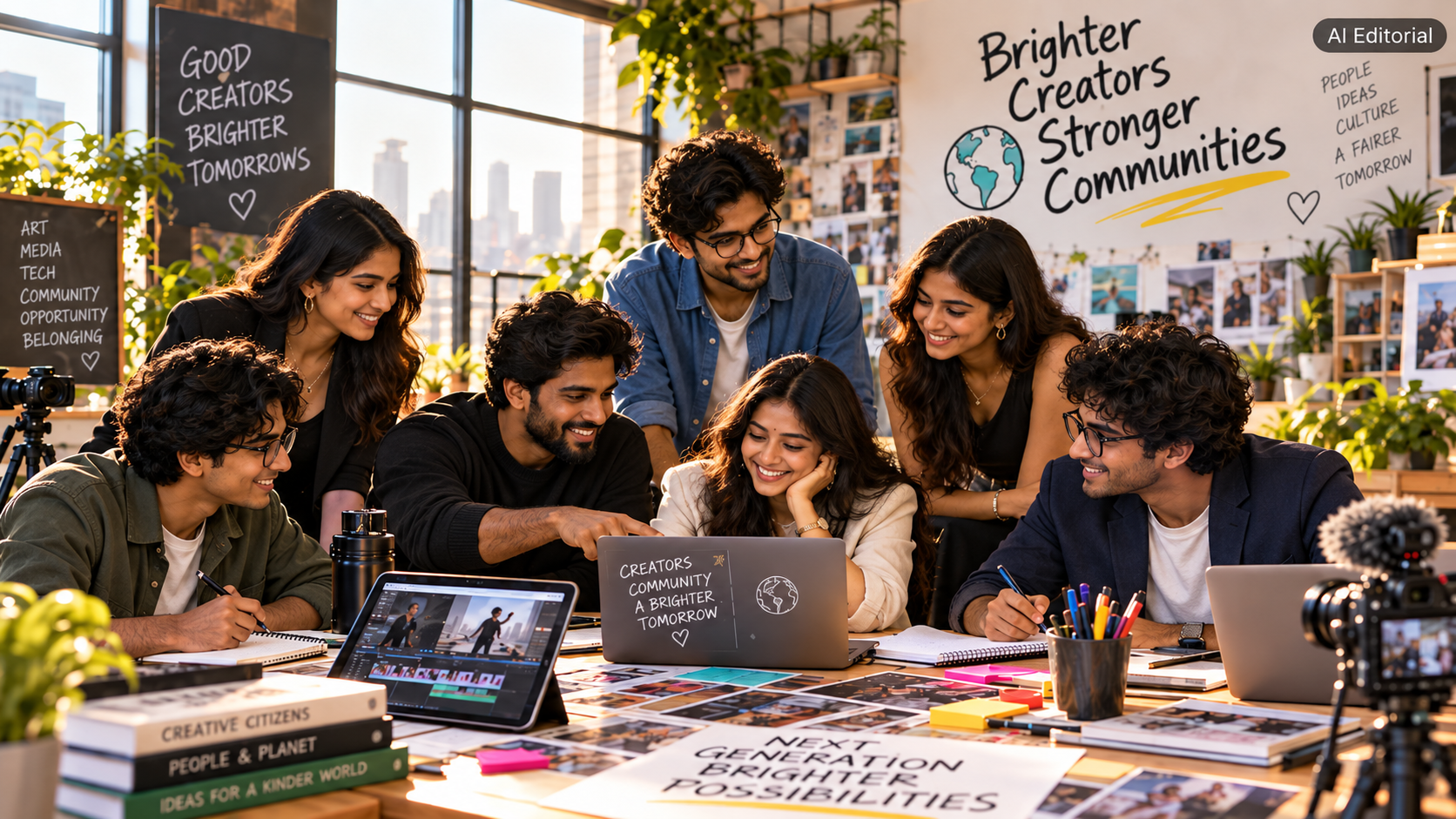
AI Editorial — Global Creator Times.
Every generation grows up with role models. Today, millions of those role models live inside a screen.
Creators now sit inside the daily lives of young people in a way that previous generations could barely imagine. They appear at breakfast, on the commute, between classes, late at night and during the quiet moments when someone is trying to understand who they are becoming.
That does not make every creator a teacher, activist or public servant. It does mean that influence has consequences.
The next chapter of the creator economy will not only be defined by who can attract attention. It will also be shaped by who understands what their attention is doing to the people on the other side of the screen.
Influence is often built through repetition, not speeches
Most creators do not change culture through a single dramatic statement. They do it through repetition.
What gets praised. What gets mocked. What is shown as normal. What success looks like. How people talk about money, relationships, appearance, ambition, failure, education, health and other human beings.
Those signals accumulate. A young audience may forget a caption but remember the worldview behind hundreds of posts.
This is why positive influence does not require every creator to become serious or political. Entertainment can still be entertaining. Fashion can still be fashion. Comedy can still be funny. Music can still be escapist. The deeper question is what kind of behaviour and values become normal around the content.
A better generation does not need perfect role models
Young people do not need creators who pretend to have flawless lives. In many cases, perfection can be more damaging than honesty.
What matters more is proportion. Showing that ambition can exist alongside responsibility. That confidence does not require cruelty. That success can include discipline, patience and failure. That being visible is not the same as being valuable.
A creator who admits mistakes, gives credit, treats people respectfully and avoids turning every moment into a performance can teach something important without ever calling it a lesson.
That kind of influence is subtle, but it lasts.
Make learning feel culturally relevant
One of the most powerful things creators can do is make learning feel alive.
Young audiences already consume enormous amounts of content. The opportunity is not to lecture them; it is to make curiosity competitive with distraction.
A creator can explain how an industry works, show how a skill is learned, reveal the process behind a creative project, make science interesting, talk about financial literacy, discuss history with context or demonstrate how technology can be used to build rather than only consume.
The format does not need to look like school. In fact, its strength may come from the fact that it does not.
Normalize building, not only buying
Digital culture is excellent at showing people what to want. It is less consistent at showing them how to build.
The next generation would benefit from seeing more of the process behind achievement: drafts, practice, rejected ideas, uncomfortable learning curves, boring routines and the quiet work that happens before visible success.
Creators can make contribution aspirational. Building a small business. Learning a language. Starting a community project. Making art. Helping a neighbour. Training for a goal. Solving a local problem.
When the internet celebrates creation as much as consumption, young people see more paths available to them.
Use visibility to widen the circle of empathy
Creators often reach people who would never meet one another in ordinary life. That gives them an unusual ability to humanize experiences across geography, class, culture and background.
A thoughtful story can make a distant issue feel personal. A respectful collaboration can introduce an audience to another community without turning that community into a prop. A creator can use visibility to direct attention toward people doing useful work who would otherwise remain invisible.
Not every cause needs a campaign. Sometimes the most valuable contribution is simply helping audiences see other people with more complexity.
Be careful with the realities you manufacture
Digital media makes it easy to create an environment where everyone seems richer, happier, more attractive, more successful and more certain than they really are.
For adults, that can be exhausting. For younger audiences, it can quietly become a definition of normal life.
Creators do not owe the internet complete access to their private struggles. But they can avoid presenting a curated outcome as if it appeared without effort, privilege, support, uncertainty or trade-offs.
A little context can protect a lot of perspective.
Technology increases the responsibility to stay human
AI is making content creation faster, cheaper and more scalable. That will expand creative possibilities, but it also raises the value of human judgment.
When content can be produced in enormous volume, creators have to decide what deserves amplification. What is true enough to repeat. What is harmful even if it performs well. What should remain private. What kind of audience relationship they are actually building.
The future will reward creators who use technology to extend their creativity without outsourcing their conscience.
Young audiences need examples of healthy disagreement
The internet often rewards conflict because conflict keeps people watching. But a generation raised inside permanent online argument also needs to see another model.
Creators can disagree without humiliating. Criticize without dehumanizing. Change their minds without treating it as weakness. Admit uncertainty without losing credibility.
Those behaviours are bigger than content strategy. They demonstrate how public conversation can work in a society where people will never agree on everything.
Impact can begin close to home
A better world is an intimidating objective. A better community is easier to imagine.
Creators can mentor someone younger, highlight a local business, support a community organization, create opportunities for emerging talent, donate skills, share useful resources or simply use their audience to solve a specific problem they understand well.
The scale does not determine the value. A creator who helps one thousand people meaningfully may leave a stronger legacy than someone who briefly entertains ten million.
The next status symbol could be contribution
For years, influence has often been displayed through access: better products, better trips, better events, better lifestyles.
There is room for another form of status: being useful.
Helping someone find an opportunity. Teaching a skill. Building a scholarship. Supporting an artist. Making an overlooked issue visible. Encouraging a young audience to take their own future seriously.
Contribution does not make a creator less aspirational. It can make aspiration feel more complete.
The bigger idea
Creators do not need to carry the weight of fixing society. That would be unrealistic and unfair.
But influence is still power, even when it arrives through humour, fashion, music, gaming, storytelling or everyday life.
The most important creators of the next decade may not be the ones who simply became famous. They may be the ones who helped millions of people imagine a healthier version of success, community and possibility.
Influence becomes meaningful when it leaves the next generation stronger than it found them.