The Tiny Chip Helping People Read Again
An ultra-thin retinal implant paired with specialised glasses is helping some people with severe central vision loss recognize letters, numbers and words again — a glimpse of how technology may return parts of everyday life once thought lost.
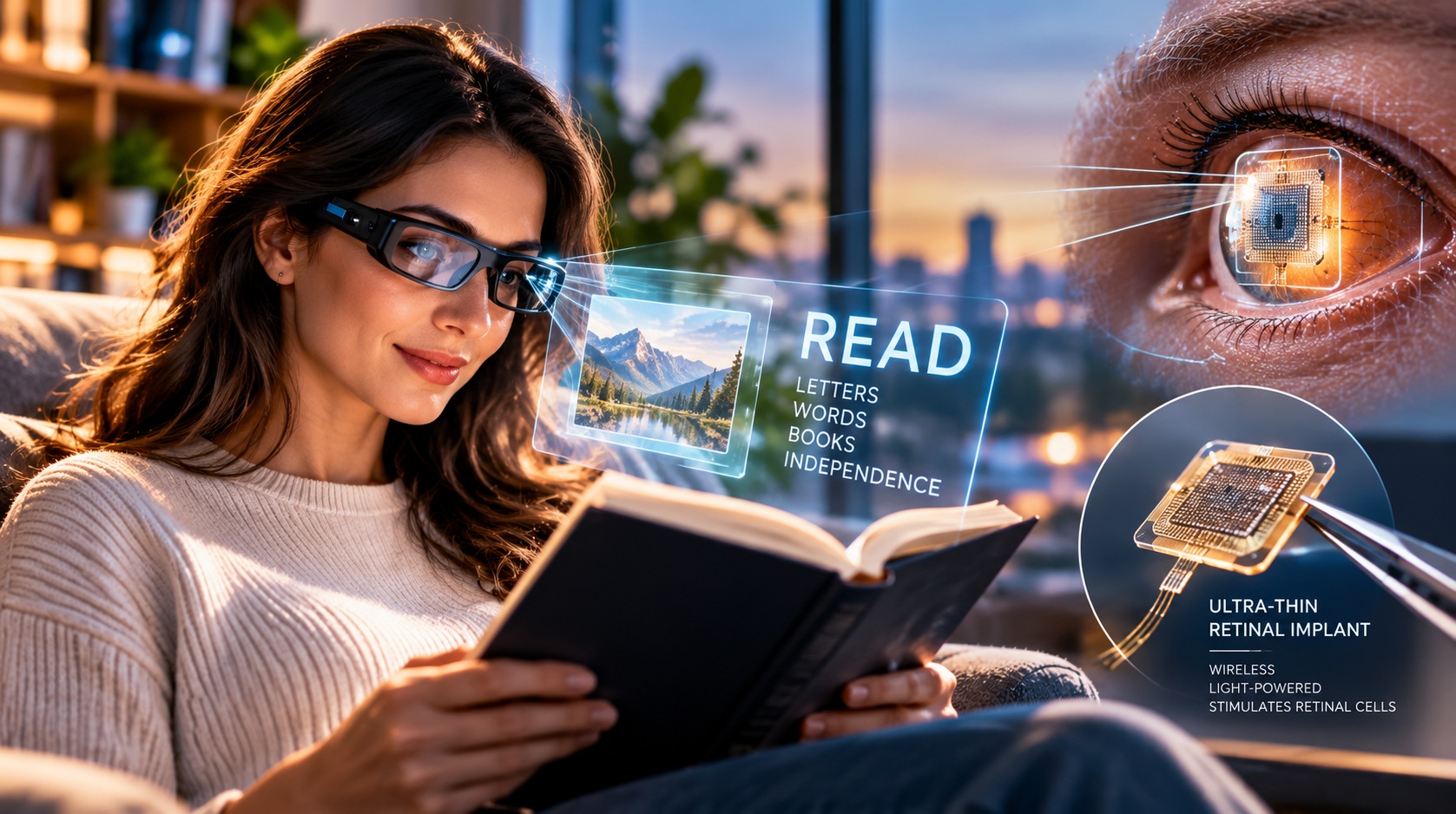
Conceptual illustration · GCT Editorial.
For Sheila Irvine, losing central vision also meant losing one of the things she loved most: reading.
She had been an avid reader for most of her life. As age-related macular degeneration damaged the centre of her vision, ordinary things — words on a page, small print, faces — became harder or impossible to see. Then she joined a European clinical trial testing a retinal prosthesis called PRIMA.
The result is the kind of technology story that sounds futuristic until a person sits down and starts reading again.
Editorial note: The hero image is a conceptual illustration and does not depict the PRIMA device or a real patient.
PRIMA does not restore normal eyesight, and it does not cure macular degeneration. What it can do, for some people with severe central vision loss caused by geographic atrophy, is create a new form of prosthetic central vision. In a pivotal clinical study, that was enough for many participants to identify letters, numbers and words again.
A 2 × 2 millimetre implant
The heart of the system is remarkably small: a wireless photovoltaic implant measuring about 2 × 2 millimetres. It is placed beneath the retina in the area where light-sensing photoreceptor cells have been lost.
Specialised glasses carry a camera that captures the scene in front of the wearer. The system processes that image and projects it toward the implant using near-infrared light. The implant converts the light into electrical stimulation that activates surviving retinal cells, allowing visual information to continue toward the brain.
In other words, the system is not replacing the eye. It is creating a technological bridge around one damaged part of the visual pathway.
What the clinical trial actually found
The strongest evidence comes from a prospective multicentre study published in The New England Journal of Medicine. Thirty-eight participants with geographic atrophy due to age-related macular degeneration received the PRIMA implant, and 32 completed the 12-month visual assessment.
Among those 32 participants, 26 — 81% — achieved a clinically meaningful improvement in visual acuity from baseline at 12 months. The study also reported serious adverse events, most occurring in the first two months after surgery; the majority of those early events resolved within two months of onset.
A separate functional measure makes the result easier to understand outside a clinic. Stanford later reported that 27 of the 32 participants assessed at one year could read letters, numbers and words using the PRIMA system.
That distinction matters. PRIMA is not giving people unrestricted natural vision. The current system provides a limited, high-contrast form of artificial central vision that requires specialised glasses, magnification and rehabilitation. Natural peripheral vision can remain alongside it.
For Sheila, the breakthrough was a letter
Irvine described the first moments of seeing a letter again as exciting. Learning to use the system was not instant. Patients train for months, learning how to position the glasses, scan across text and interpret the new visual signals.
That rehabilitation is part of the technology. A successful implant is only one side of the system; the brain also has to learn what the new information means.
Over time, Irvine began reading again and challenging herself with crosswords and small print. The achievement sounds modest compared with the language often used around futuristic technology. That is precisely what makes it powerful. The breakthrough is not a hologram or a science-fiction superpower. It is the return of an ordinary human activity that had disappeared.
From clinical trial to real-world treatment in Europe
The story has moved beyond the original trial. In July 2026, PRIMA received European approval for use in severely sight-impaired adults with geographic atrophy due to dry age-related macular degeneration. The official PRIMA patient site now describes it as approved in Europe to restore central vision for that indication, while noting that it has not received market approval outside the EU/EEA.
That does not make the technology appropriate for every person with sight loss. Eligibility depends on the disease, the remaining retinal structures, surgical considerations and specialist assessment. It also does not mean that the device restores full-colour, wide-field or natural vision.
The next question: can the same idea help other diseases?
This month brought a new reason to watch the technology. Science Corporation disclosed an early rehabilitation result from the first PRIMA patient with Stargardt disease in its ongoing PRIMAlia study in Australia. The patient had received the implant in May; according to the company, he saw a letter in his first rehabilitation session and read a word in his second.
That is not yet evidence that PRIMA works broadly for Stargardt disease. It is an early company-reported result from one participant in an ongoing exploratory study, not a completed peer-reviewed efficacy trial. The PRIMAlia study is recruiting people with inherited retinal degeneration, including Stargardt disease and retinitis pigmentosa, to evaluate safety and visual outcomes over time.
But it illustrates why retinal prostheses are so interesting. If the inner retinal pathway and optic nerve remain capable of carrying information, engineers may be able to build increasingly sophisticated interfaces where photoreceptors have been lost.
The technology still has limits
Today’s PRIMA system should not be confused with normal sight. The current field of prosthetic vision is narrow. The image is high-contrast rather than natural colour. Faces remain difficult. Patients need hardware and training. Surgery carries risk, and long-term performance matters as much as an impressive first demonstration.
Researchers are already working on denser implants and better processing to improve resolution and expand what users can perceive. Whether those next generations approach more natural vision will require new clinical evidence, not just engineering ambition.
Why this story matters
Technology is often measured by speed, scale and computing power. Medical technology offers another measure: what part of ordinary life can it return?
A 2-millimetre chip cannot recreate everything the human eye can do. But for people who had lost the central vision needed to read, even a few letters can represent independence, curiosity and access to a world they thought had closed.
Perhaps the most extraordinary technology is not the technology that makes humans superhuman. It is the technology that gives a piece of ordinary human life back.
Sources & reporting notes
This GCT feature is based on the peer-reviewed PRIMAvera study in The New England Journal of Medicine; reporting from UCL, Moorfields and Stanford; July 2026 European regulatory reporting; and October 2026 reporting on the ongoing Stargardt study. The Stargardt result is explicitly treated as an early, single-patient company-reported observation rather than established efficacy.
- New England Journal of Medicine — PRIMAvera clinical study
- UCL / Moorfields — PRIMA trial results and patient reporting
- Stanford Report — Sheila Irvine and PRIMA
- TechCrunch — July 2026 European approval update
- TechCrunch — October 2026 Stargardt study update
Medical note: This article reports on medical technology and clinical research. It is not medical advice and does not imply that PRIMA is suitable or available for every person with vision loss.